Bluetooth: from Beacons to Channel Sounding
The word "Bluetooth" in the sentences hides three different technologies with an exact difference of an order of magnitude: beacons by signal strength, angular detection with an antenna array, and phase distance measurement, which appeared in Bluetooth 6.0. Let's look at what works today, what a silicone bracelet with a tag can do, and why a wet guest hand is the worst mounting position for the radio tag.
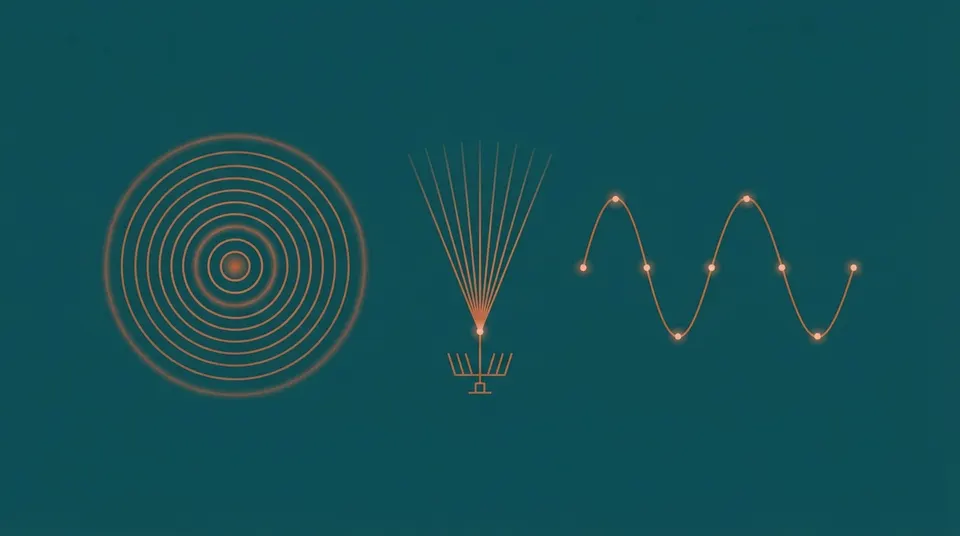
If the commercial proposal says "positioning via Bluetooth", it can mean three completely different systems. The first will determine that the guest is somewhere in the hall. The second one will show its position with an accuracy of about a meter and will cost like half of the UWB. The third one has existed since 2024, in 2026 it reached serial chips and promises to change the economy of guest bracelets - but so far with reservations that are more important than promises.
Let's take all three in order, because the confusion between them is the main reason why the customer does not get what he expected.
Two architectures that are constantly confused
Before talking about accuracy, you need to separate two fundamentally different schemes. Both are called "Bluetooth positioning", but these are different projects, different money and different legal regime.
| The tag is broadcasting, the infrastructure is listening | The infrastructure is broadcasting, the phone is listening | |
|---|---|---|
| What is placed on the object | Receivers (locators) with power and network | Beacons on batteries, without a network |
| What does a person have | Tag, bracelet, badge | A smartphone with the app installed |
| Who calculates the position | Object Server | Guest's phone number |
| Who sees the picture | Object, in real time | Guest; object — only if the data is sent to the server |
| Coverage | Everyone who was given a tag | Only those who installed the app and gave permissions |
| Cost of infrastructure | High (cable, PoE) | Low (beacons are glued to the wall) |
| A typical task | Analytics, security, accounting | Navigation, content, push notifications |
The first scheme is RTLS: the object knows where the labels are. The second is navigation: the phone knows where it is. And the main practical conclusion: the second scheme does not provide flow analytics — it gives it only for the proportion of guests who installed the application and did not disable permissions. At a facility without a strong application, these are percentage units, and it is impossible to build operational solutions on this.
Further in the article, we are mainly talking about the first scheme, because it is she who answers the question "where does the guest go".
Generation One: beacons and signal strength
The most massive and most overrated variety. The label periodically broadcasts a short packet, the receiver measures the received signal level (RSSI) and recalculates it into a distance according to the attenuation model.
The problem is that the attenuation model is an approximation that breaks everything: reflections from tiles and glass, the human body, other equipment in the same range, even air humidity. On paper, it turns out three to five meters. On the object — "it is clear in which half of the hall", and this is not a drawback of a particular vendor, but a property of the method.
Hence the two honest uses of RSSI, in which it is good and cheap:
Presence and proximity. The guest is next to the exhibit, to the terminal, to the entrance to the zone. The question is not "where is he", but "is he close to this point", and RSSI answers it reliably.
Zones with clear boundaries. If the zones are separated by walls, and the receiver is in each, the system confidently distinguishes the zones — not because it accurately measures the distance, but because the signal from the next room is weaker. This is a working, inexpensive scenario: level 1 zonal positioning from the first article in the series.
Fingerprint and its reverse side. To get more from the RSSI, they build a radio map: they walk around the object, record what the set of signal levels at each point looks like, and then compare the current measurements with the map. The accuracy increases to 1-3 meters, and a new problem appears: the radio card is outdated. They rearranged the racks, hung up the metal structure, put up a new display case — the card is lying, and a second bypass is needed. In an object where the situation is changing (and in a thermal spa complex it is changing: screens, sun beds, seasonal decoration), this is a constant item of expenditure.
The beacon formats — Apple's iBeacon and Google's Eddystone — are just conventions about what is transmitted in a packet. They don't affect accuracy; they affect how the phone perceives it.
Generation Two: Angular Definition (AoA)
In Bluetooth 5.1, a directional detection mechanism has appeared: the tag transmits a special tail of the packet, and the receiver with an antenna array measures the phase difference between the elements of the array and calculates the angle at which the signal came. Two or three such receivers give the position of the intersection of directions.
This is a different accuracy class. The Finnish Quuppa is considered the benchmark of the market here: according to the company's materials, accuracy is claimed from about ten centimeters to proximity and presence modes, a delay of 100 ms, a refresh rate of up to 50 Hz and simultaneous tracking of thousands of objects; integrator suppliers have more cautious formulations — "less than a meter" and "submeter accuracy".
Two remarks that should be kept in mind.
The spread of the stated figures is not an accident. Ten centimeters in the description and half a meter in the user's review are the same system in different conditions. How to read such statements is discussed in the methodical article: without specifying the percentile, line of sight and density of locators, the figure is not verifiable.
Installation is more complicated than it seems. In the reviews of angular detection platforms, there is a regular remark about the complexity of the installation, and the reason is physical: the grid measures the angle, which means the system is extremely sensitive to the orientation of the locator and to the accuracy of its coordinates. An error of one degree at a distance of twenty meters is a third of a meter on earth. Therefore, in AoA projects, the installation and geodetic binding of locators is not a formality, but an essential part of the cost.
Where AoA is appropriate: workshop and warehouse (personnel, equipment, tools), gyms, hospital, large exhibition spaces, objects where the coordinate is needed, but the centimeter accuracy of the UWB is not needed. For a thermal spa complex, this is usually redundant — there are enough zones there.
Third Generation: Channel Sounding
The most interesting thing that has happened in this technology in ten years, and what is almost not written in Russian.
What is it. Bluetooth 6.0 introduced a mechanism that measures the distance between two devices directly. According to the Bluetooth SIG materials, two methods are used: phase measurement (phase difference at multiple frequencies — according to the descriptions of implementations, about 79 channels) and measurement of the time of circular signal transmission, and the second serves, among other things, as protection against attacks with substitution and retransmission. That is, unlike RSSI, this is a real distance measurement, and not a recalculation of the signal level according to the model.
How the specification evolved. Debut in Core 6.0; in Core 6.2, tools for detecting attacks based on amplitude manipulation were added; Core 6.3 was released in May 2026 and added, among other things, updated reporting on the accuracy of time measurement and the transmission of measurement data within the exchange itself.
Chips. Nordic (nRF54L15, nRF54H20), Silicon Labs (EFR32xG24), NXP (KW47), Infineon (CYW20829), TI (CC2340 family) have support. These are serial universal BLE controllers, not specialized rangefinders — and that's why the technology is economically interesting: the label on Channel Sounding is like a regular BLE label.
What accuracy is real. Here you need to be extremely honest, because the spread of statements is great:
- Silicon Labs documentation on phase measurement gives ± 0.3 m at distances up to 5 m and ± 0.5 m further;
- in demonstrations on reference boards, 10-30 cm is shown in line of sight.;
- in a cluttered environment with no line of sight, the figures degrade to 0.5–1 m.;
- The description of the Nordic demonstration at Embedded World 2026 includes "about half a meter to a meter";
- and, most importantly, Silicon Labs themselves note that it is difficult or impossible to consistently reach 0.5 m with one antenna: device orientation, the human body and multipath interfere.
The last point is the key for our reader. The mark in the bracelet on the wet hand of the guest is in the worst possible conditions: it is pressed against the body, the orientation changes every second, there are reflective tiles and water around. There are works on error correction according to inertial sensors — that is, the label is trying to understand how it is rotated in order to correct the measurement. This is a sign of both the promising direction and the fact that the problem is real.
What else is important for guest bracelets. Classic Channel Sounding requires an established connection between two devices, and this does not scale well: a thousand bracelets — a thousand connections. In 2026, work appeared on a non-connecting mode using periodic response broadcasting (PAwR), which is exactly what is needed for mass labels: energy saving and scale. This is still a research topic, not a product, but it's worth keeping an eye on — it depends on it whether the phase measurement in bracelets will become mass.
Practical conclusion for today. Channel Sounding is something for which it is worth designing a stock, but not something for which it is worth setting a critical task in 2026. If you are currently choosing a bracelet and readers, it is reasonable to ask the supplier if he has a line on chips with support for Channel Sounding and upgrade plans — so that in two years not to change the entire fleet of tags.
Media, readers, and the tagging network
Tag receivers live on PoE switches: the network and cable here are as much a part of the project as the sensors themselves.
Silicone RFID Wristband for Wet Areas
One bracelet is a pass, a locker key and a guest bill. Withstands water, chlorine and high temperature.
Request a KPWall-mounted card reader and wristbands
Reads RFID wristbands and cards at the entrance to the zone. The backlight shows the guest if he is missed. Vandal-proof housing withstands wet areas.
Request a KPManaged Access Switch with PoE
It feeds cameras and access points via twisted pair and separates the guest network and the cash register circuit.
Request a KPWi-Fi hotspot for wet areas
Covering the pool and steam rooms without dips. Version with protection against moisture and condensation.
Request a KPBattery, Density, Scale
The tag battery is determined by the broadcast interval. A tag that broadcasts once a second lives for years on a coin battery; a tag that broadcasts ten times a second lives for months. Phase measurement is energetically more expensive than simple broadcasting, and this is another argument for hanging complex things on the ceiling and giving the guest the simplest possible.
Density of receivers. For a zonal scheme — a receiver per zone, sometimes one for several small rooms. For AoA— there are overlapping locators arranged so that any point is viewed by at least two from different angles. The general pattern: the higher the required accuracy, the closer the density approaches the UWB, and with it the cost of cable work, which, according to open estimates, makes up most of the budget of any coordinate system.
Scale. 2.4GHz — Common and noisy range: there is also Wi-Fi, there are also household appliances. As the number of tags increases, the proportion of collisions increases, and the frequency of successful receptions decreases. The question "how many labels per cell at the stated refresh rate" is as mandatory for BLE as for UWB.
Where Bluetooth breaks down
The human body. The main factor. The label shielded by the body loses the signal by an order of magnitude, and this gives an error depending on the pose, not on the system.
Water. The pool, splashes, wet skin — all this absorbs 2.4 GHz. The bracelet under water is not readable at all, and this must be taken into account in scenarios: "guest in the bowl" for BLE means "the label has disappeared", and the system must be designed so that the disappearance is not interpreted as "gone".
Reflections. Tiles, glass, mirrors, stainless surfaces. This is fatal for RSSI, a source of false directions for AoA, and a source of scatter for phase measurement.
Ethereal competition. An object saturated with guest Wi-Fi is an object with a busy 2.4GHz band. A reasonable practice is to take away guest Wi-Fi at 5 GHz and above, leaving 2.4 for tags.
Replacement of beacons. A beacon is a broadcast device without authentication; its packet is easy to repeat. This is not essential for navigation and content, it is critical for access and accounting, and therefore beacons are not used as a means of access.
Cases on Wednesdays
Museum and exhibition. Classics of the genre: beacons at the exhibits plus an application with content. It works, but you need to remember about limiting the coverage of the application. For analytics on all visitors, the museum needs counters at the entrances to the halls, not beacons.
Shopping center and retail. Zonal positioning by receivers works for personnel and for inventory. For buyers without a tag and without an application, BLE is useless — the analysis of alternatives in the article about sensors.
Fitness club. A good scenario: the label in the club card or bracelet plus the receivers by zones give the actual attendance of halls and group classes, and not the entries in the schedule. This is the data that is used to rebuild the class grid.
Thermal spa complex. The optimal role of BLE here is an addition to RFID: the marks of the bracelet give accurate events at the reading points, and the BLE mark in the same bracelet gives a real—time zone between them. This closes two tasks that RFID does not close: finding a lost child and monitoring time in a hot zone.
Warehouse, workshop, construction site. Zones and presence on the BLE, the exact coordinate in dangerous areas on the UWB. The most common hybrid scheme in the industry.
Clinic. The search for equipment is a massive and cheap application: infusion pumps, armchairs, trolleys with tags and receivers in the corridors. This is the case when zonal accuracy is sufficient and the value is high.
Guest's phone number: what really works
Separately, about the scenario "the guest receives a notification when he passes by the bar."
Technically, it works: the app sees a beacon in the background and shows a notification. Practically, this has three limitations, and all are serious.
Coverage. You need an installed application. The proportion of guests with the app at a facility without a strong loyalty program is measured in percentage units.
Permissions. Both iOS and Android require the user to have explicit permissions for Bluetooth and to work in the background, and the policy is tightened with each version. The user who refused does not exist for the system.
Advertising by law. A push notification with an offer to buy is an advertisement distributed over telecommunications networks. Russian advertising legislation requires the subscriber's prior consent to such distribution, and consent to the processing of personal data does not replace it. This is a question for a lawyer before starting mechanics, not after. The analysis of the legal outline is in the article about the law.
Conclusion: beacons with notifications are a tool for working with a loyal audience that already uses your application, and not an analytics or mass sales tool.
What is the law in Russia
The range. 2.4 GHz is a band for short—range devices, the application is massive and does not require individual permissions, subject to power restrictions. The equipment must have documents of compliance with the requirements of the EAEU. This is the most relaxed part of the topic in terms of permissions, unlike UWB.
Data. The tag ID itself is impersonal; associated with the guest in the accounting system is personal data with all responsibilities. An impersonal contour is reasonable for analytics, as described in the article about RFID.
The label on the employee. Separate mode: local regulatory act, employee notification, control boundaries. Technically, this is the same receiver on the ceiling, legally — a different project.
Checklist for talking to the supplier
- Which generation: RSSI, AoA or Channel Sounding?
- What kind of architecture: do the receivers of the object listen to tags or do beacons broadcast to phones?
- Accuracy in CEP50 and CEP95, at what density of receivers and under what conditions?
- Do I need a radio card and who reshoots it when the situation changes?
- How many locators are required for our plan and show the placement.
- What accuracy of installation of locators is required and is the binding included in the price?
- How does the system behave when the label is closed by the body and wet?
- What happens when a guest enters the water and the mark disappears?
- How many labels per cell at the stated refresh rate?
- The service life of the tag at the stated broadcast interval and who changes the batteries?
- Is there a line on chips with support for Channel Sounding and a transition plan?
- Is the impersonal mode and the unloading of raw events supported?
- Is it possible to combine the tag with our RFID wristband in one case?
We will select a zonal scheme for your object
Let's calculate how many receivers are needed for the zones you want to see, and whether the coordinate is needed at all.
- We will respond within a working day
- Let's clarify the task, the zones of the object and the restrictions
- We will propose a solution, a pilot order and an estimate
Is it more convenient in the messenger?
+79262103289Employees respond from 9:00 to 23:00 Moscow time, every day
How can we help
Low-voltage systems
Structured Cabling and local area networks, Wi-Fi, video surveillance, access control systems, sound and video in the halls, server rooms — from survey and project to commissioning and executive documentation. It is better to connect at the construction stage, but we also work with existing facilities.
СКСIP-видеонаблюдениеЗвук по зонамСКУД
ACCESS CONTROL SYSTEM
Turnstiles, wristbands, readers and lockers associated with 1C: the guest has passed, the visit has been written off, and the report card converges with the checkpoint.
SigurТурникеты и браслетыБраслеты и шкафчикиСКУД
Structured Cabling and LAN
We design and install the cable system and the local network of the facility: for ticket offices, turnstiles, cameras, employees and guest Wi-Fi.
СКСWi-FiСетевое оборудованиеСерверы и СХДFrequent questions
Bluetooth is cheaper than UWB — how much?
It is essential in terms of equipment: receivers and tags are cheaper, and with a zonal scheme they need many times less. But if you require coordinate accuracy from the BLE, the density of the receivers increases, along with the cable and installation, and the gap is reduced. The main saving of BLE is not in the price of the device, but in the fact that fewer devices are needed for a zonal task.
Is it possible to get an accuracy meter on Bluetooth?
On the angular definition — yes, with proper placement and installation. On the phase measurement, according to manufacturers, about half a meter is a meter in favorable conditions, worse in real conditions. On RSSI, no, regardless of promises.
Should I wait for Channel Sounding or take AoA now?
If there is a task today and it is about the coordinate, AoA is more mature and predictable. If the task is about zones, take a zonal scheme and select tags on chips with Channel Sounding support so as not to change the fleet when the technology reaches mass bracelets.
Is it possible to embed a BLE tag in an existing bracelet?
Combined carriers (passive RFID plus active BLE) exist, but this is a different case, a different price and a battery. For a guest bracelet that is lost and treated with disinfection, this is a noticeable change in the consumable part — you need to count on the park, not on the piece.
Will the system work if the guest turns off Bluetooth on the phone?
For a scheme with a label — yes, the phone does not participate at all. For a scheme with an application, no, and this is the main reason why it cannot be relied on in analytics.
Sources
Sources
- Bluetooth SIG, Channel Sounding overview — measurement methods and purpose
- Quuppa — declared characteristics of the angular definition (manufacturer's data)
- Gartner Peer Insights, reviews of the Quuppa platform — comments on the complexity of installation
- Correction of phase measurement error by inertial sensors
- Unconnected Channel Sounding via PAwR — scaling to a large number of labels
- Nordic, Channel Sounding demo at nRF54L15
- Overview of Channel Sounding Applications — Summary of chips and accuracy
Other articles in the series
Bracelet as a key: RFID from locker to Flow analytics
The silicone bracelet of the thermal spa complex writes the events "entrance", "locker", "bar", "exit" every day — this is a ready-made visit funnel that almost no one reads. We analyze what RFID can and cannot do, how Classic differs from DESFire and why it is a matter of money, how to assemble a route from the marks on the reading points and where this route lies.
UWB: centimeters and the price of centimeters
UWB is the only radio technology that honestly gives tens of centimeters indoors. We analyze physics, measurement methods, chips and vendors, the new 802.15.4ab standard with a narrowband assistant, the real cost structure (where cable is more expensive than tags) and the legal regime of UWB devices in Russia. And we correct the main myth of the topic: in Puy du Fou, actors are tracked, not viewers.
Wi-Fi: What's left of tracking after MAC randomization
Passive collection of MAC addresses of smartphones was the cheapest flow analytics, and address randomization in iOS and Android broke it. We analyze what exactly has stopped working, why de-randomization is a bad idea both technically and legally, why in Russia "anonymous guest Wi—Fi analytics" is impossible by definition, and what really came to replace it: Wi-Fi RTT and sensing according to the 802.11bf standard.