UWB: centimeters and the price of centimeters
UWB is the only radio technology that honestly gives tens of centimeters indoors. We analyze physics, measurement methods, chips and vendors, the new 802.15.4ab standard with a narrowband assistant, the real cost structure (where cable is more expensive than tags) and the legal regime of UWB devices in Russia. And we correct the main myth of the topic: in Puy du Fou, actors are tracked, not viewers.

UWB is the very technology that makes "10 centimeters accuracy" appear in presentations. And the only radio technology in this series that really has such a figure, and not just promised.
Therefore, talking about UWB is not a conversation about whether it works. It works. This is a conversation about two things: how much these centimeters cost and whether you need them. The answer to the second question is negative much more often than the UWB seller assumes — and to make it clear, let's start with how the technology works.
Physics: why a short pulse solves the problem of reflections
Conventional radio systems operate on a narrow band and continuous signal. The problem of the room is that the signal comes to the receiver in many ways: direct and reflected from the walls, floor, tiles, water. A narrowband receiver adds them up into one sum and cannot distinguish which part came directly.
UWB transmits very short pulses occupying a band of at least 500 MHz — this is how ultra-broadband devices are defined in the Russian regulatory document. A short pulse in time means it is possible to distinguish the arrival of a signal with a resolution of nanoseconds, and a nanosecond is thirty centimeters of the path of light. The receiver sees the reflections as separate, later pulses and can choose the first to arrive, that is, the direct path.
Hence all the properties of the technology:
- multibeam resistance is the main advantage, especially in a room with tiles, glass and metal;
- low spectral power density — the energy is spread over a wide band, the limit is -41.3 dBm / MHz, that is, the device almost does not interfere with other systems and itself almost does not create interference.;
- short range is a consequence of low power: tens of meters, not hundreds;
- accuracy in tens of centimeters with line of sight and correct geometry.
The current standard of the radio interface is IEEE 802.15.4z, the working channels are mainly around 6.5 and 8 GHz (channels 5 and 9). Car digital keys and the exact search function in smartphones work on the same standard.
Measurement methods: TWR, TDoA, PDoA
Three schemes between which to choose when designing. The difference is not academic: it determines both the tag battery, the system capacity, and the cost of the infrastructure.
TWR is a two—way exchange. The tag and the anchor exchange packets, the distance is calculated by the time of the turn. Distances of up to three anchors give a point. Plus: there is no need to accurately synchronize the anchors with each other. Minus: the label is actively transmitting and waiting for answers, that is, it consumes energy, and each label occupies ether for the entire exchange cycle. This limits the number of labels.
TDoA — the difference in arrival times. The label simply broadcasts, and the anchors synchronized with each other record who received the impulse earlier. According to the time differences, the position is calculated. Plus: the tag works in the "said and sleeps" mode, the battery lives longer, there may be a lot of tags in the system. Minus: the anchors must be synchronized with nanosecond accuracy, that is, cable synchronization or wireless with high stability is needed — the infrastructure is more expensive and demanding.
PDoA is the phase difference on the anchor antennas. Allows you to get the direction of the label and in some configurations to do with one anchor for rough positioning. It is used where a dense network of anchors cannot be installed.
Rule of thumb: there are a lot of tags and the battery is important — TDoA; few tags and ease of installation is important — TWR; the point of interest where you need to know the direction and distance is PDoA.
Chips: Who makes the radio
Qorvo (formerly Decawave). The DW1000 is the chip on which the entire industry grew up, and is still found in equipment. DW3000 is a modern generation with 802.15.4z support. This is important for the customer for one reason: the solutions of most RTLS vendors are built on these chips, that is, their physics are the same, but the algorithms, synchronization, platform and installation engineering differ.
NXP Trimension. The second large family is widely used in automotive digital keys and consumer electronics.
Apple U1 and U2. Chips in iPhones and watches, because of which UWB has become widespread in smartphones. For objects, this is a potential way of "positioning without issuing a label", but with restrictions, which are discussed below.
New generation: 802.15.4ab. In 2026, something has appeared that changes the perspective of technology. STMicroelectronics introduced the ST64UWB family with support for both 802.15.4z and the upcoming 802.15.4ab, and one of the models includes a radar function on UWB and an accelerator for machine learning. The key innovation of the standard is a narrowband assistant (narrowband assist): A narrowband channel in the region of 5-6 GHz is added to the ultra-wideband measurement, which takes over the service exchange. Imec announced in June 2026 the first receiver implementing this mechanism and a fourfold increase in range.
What this means practically: less energy per tag, more range per anchor, that is, fewer anchors per the same area. In other words, the main drawback of UWB — the cost of dense infrastructure — is being addressed right now. At the time of writing, this is silicon at the sample stage for large customers, and not products in the catalog. But if you are designing a system with a horizon of five years, this paragraph should be discussed with the supplier.
Separately, it is worth noting the radar function in the UWB chip: the same module that measures the distance to the tag can work as a presence and motion sensor without any tag. For objects, this brings UWB closer to the topic of sensors without cameras and without labels.
Vendors: who builds the systems
Everyone's physics is similar, the difference is in the platform, synchronization, installation tools and industry specialization.
Europe. Eliko (Estonia) — compact anchors and tags, open integration, is strong in the entertainment and industrial niche. Sewio (Czech Republic) is an open platform, bought by HID Global in August 2024. Kinexon (Germany) — industry, logistics and sports, including wireless mesh architecture for rapid deployment. Pozyx (Belgium) — industry, transparent engineering recommendations. Ubisense (UK) — heavy manufacturing, automotive industry. Zebra is a major integrated player with its own equipment.
Asia. Blueiot and a number of Chinese manufacturers are mass anchors and tags at a noticeably lower price; Eforthink (Chengdu) in June 2026 announced navigation for UWB smartphones in shopping malls, airports, hospitals, exhibition centers and museums — that is, without issuing tags, due to the chip in the guest's phone. Dmatek is an equipment that is found in projects on the Russian market.
Russia. RTLS — development and production in Russia, tags with support for several technologies at the same time (UWB, Bluetooth, GNSS, LoRaWAN), including explosion-proof anchors for hazardous industries. Merusoft builds systems on Dmatek equipment and claims an accuracy of 10-30 cm. For facilities where delivery, service and compliance documents in Russia are important, this is the first round for a request.
Puy du Fou: how it really works
The most popular UWB case in the entertainment industry, and almost always it is retold incorrectly. We will analyze it exactly, because a practical conclusion follows from an accurate retelling.
The French park Puy du Fou in the show Le Premier Royaume takes about five hundred spectators through a series of scenes — the audience goes on foot, without tags. Eight actors perform strictly synchronized outputs, and the system needs to know where the artist is in order to turn on the microphone, light and effect in time.
Initially, RFID was used, and it failed: according to the head of the park's automation, the measurements were only approximate, which caused a delay that was noticeable to the audience. About six months after the start of the production, RFID was replaced with the Eliko UWB system on Qorvo chips, and the antennas were built into the existing scenery so that they could not be seen by the public. In another production of the same park, UWB tags work in conjunction with the optical system: the optics guide the position, and the radio tags are responsible for automatically determining which character entered the scene.
Why this is important. From this case, it is usually concluded that "UWB allows you to bind effects to the movement of viewers." The correct conclusion is different: the effects are tied to the movement of eight artists — that is, eight tags worn by employees who are required to wear them, in a pre-known geometry of the scene, where you can put the anchors where you need.
To bind the effect to the guest, you need a label on each guest, covering all the areas where the guest walks, and working with the fact that the guest will remove the label, wet it, cover it with his body and lose it. This is a project of a different scale and a different price. It's not impossible—immersive quests and shows with small groups do that—but you can't compare it with eight marks on actors.
Sport: the only niche with independent validation
It is curious that the most honest data on the accuracy of the UWB was given by sports science, where the systems are checked against the benchmark, and not against the presentation.
Kinexon claims an accuracy of better than 10 cm and a delay of less than 100 ms for its sports platform. Independent validation work compared the system with the standard on infrared cameras in handball and football and confirmed that it corresponds to the current level of determining the position of players and the ball — with the caveat that the sample was small.
But here is a detail that is not in any presentation, and it is important for any object: in the study of the accuracy of the UWB system in tennis, it is shown that with sharp accelerations and changes of direction, the error increases noticeably. That is, the declared accuracy is accuracy on quiet movement. The child who ran zigzagging through the water park is the worst case for both the filter and the radio.
The infrastructure on which accurate positioning lives
The main cost of the coordinate system is cable, power and server part, not tags.
Managed Access Switch with PoE
It feeds cameras and access points via twisted pair and separates the guest network and the cash register circuit.
Request a KPStructured cabling system
The project, installation, marking and passport of the Structured Cabling. Saves weeks with any revision.
Request a KPRack Application and Database server
Holds 1C, access control system and video analytics. We consider the configuration for the number of jobs and the depth of the archive.
Request a KPUninterruptible power supply for the server room
Keeps the cash register and server circuit in case of power failure and gives time to shut down correctly.
Request a KPEconomics: what you pay for
The main mistake in evaluating UWB is to count the cost of the label. The label is the cheapest part.
Open benchmarks (all external estimates, not our pricing):
- anchor — 120-350 € plus installation, according to the RTLS cost summary;
- the infrastructure for submeter accuracy is 15-40 € per m2, approximately 30-60 anchors per 5000 m2 according to the same summary;
- density — one anchor per 150-300 m2 according to Pozyx recommendations, depending on the number of obstacles;
- tags — $ 40-100 per piece in one estimate, up to £ 100-300 per unit of the equipped object in another;
- installation and cable infrastructure — from 60 to 85% of the budget according to various open estimates, including site inspection and PoE power;
- maintenance — 15-25% of the cost of equipment per year;
- The estimate of the three—year cost of ownership for a park of 500 tags is 350-800 thousand. $ in one of the publications of 2026.
The spread is large, and this is normal: it reflects the spread of requirements. But the structure is stable, and three practical conclusions follow from it.
First: saving on anchors is the main lever. Each anchor is not only a device, but also a cable, a route, a mount, a point in the act. Therefore, any reduction in the required density (another technology in non-responsible zones, a zonal scheme instead of a coordinate one, a new generation of chips with a longer range) saves a multiple.
Second: the area is more important than the number of objects. It is cheaper to equip two hundred UWB tags on an area of 1000 m2 than twenty tags on an area of 10,000 m2. This is the opposite of the intuition with which the customer usually comes.
Third: a hybrid is almost always cheaper. The UWB in the area where centimeters are needed, and the zonal system in the rest of the area is a typical and economically justified solution. For more information, see the article about hybrids.
What is the law in Russia
UWB has its own specifics here, and you need to know it before purchasing.
The main document. Ultra-wideband devices in Russia are regulated by the decision of the SCR No. 09-05-02 of December 15, 2009, issued as Appendix No. 16 to the decision of the SCR No. 07-20-03-001 of May 7, 2007 "On the allocation of radio frequency bands to short-range devices". The allocated band is 2.85–10.6 GHz. A UWB device is a short-range device that uses a radio frequency channel with a width of at least 500 MHz to transmit or receive data.
Permissions. The general principle of the solution 07-20-03-001 is that the use of the bands specified in the applications for short-range devices is carried out without registration of separate solutions of the RFCs and permissions for the use of radio frequencies for each specific user. This is the main thing that interests the customer: if the conditions of the application are met, a separate frequency permission for your facility is not required.
Restrictions from the app. In the conditions of use, according to publications reproducing the text of the application, there are prohibitions on use on board aircraft during climb and descent and at airport cargo terminals. The full list of conditions, including power requirements and types of applications, should be read according to the current version of the document.
What to check before purchasing:
- the current version of the decision and appendix No. 16 — the document has changed, and there are discrepancies in open publications;
- working channels of specific equipment and their entry into the permitted band;
- documents of compliance with the requirements of the EAEU for the supplied equipment;
- the need to register electronic means for your type of application — this issue is resolved according to the current rules and it should be addressed to the supplier in writing.
The story of Apple. A useful plot showing that the regulation here is real, not formal: the UWB function in the iPhone was limited for Russia due to the lack of permission from the regulator for the desired range, and Apple's earlier application for frequencies around 6 GHz was refused. This leads to a practical conclusion for projects that rely on UWB in guests' smartphones.: such a scenario in Russian conditions should be checked separately, and not taken for granted by foreign publications.
The legal part concerning the movement data itself is discussed in the article about the law — here is only the radio frequency aspect.
Restrictions and how they cost
The price of density. The main limitation, and it is economic. Bypass: hybrid, zone circuit on the periphery, UWB only in critical areas, waiting for equipment on 802.15.4ab with a longer range.
Battery of the active tag. A label with a high refresh rate lives for weeks and months, and the label fleet needs to be maintained. Bypass: TDoA instead of TWR, adaptive refresh rate (often when the object is moving, rarely when it is standing), charging stations for staff wearable tags, and for guests — abandoning active tags in favor of a passive bracelet.
Water and metal. UWB tolerates a difficult environment better than others, but does not cancel physics: the label does not work underwater, the metal structure creates a shadow. Bypass: placement of anchors taking into account the design, mandatory examination, interpretation of signal loss as a separate state, and not as "gone".
Lack of line of sight. Systematic overestimation of the distance through an obstacle. Bypass: more anchors, algorithms for rejecting measurements through the wall, a passability map.
Sudden movement. The growth of the error during accelerations and reversals, confirmed by independent studies. Bypass: do not build critical scenarios on instantaneous values, use confirmation on several dimensions.
Noise immunity. UWB is resistant to conventional interference, but there are studies of targeted suppression of UWB measurements on serial chips. It doesn't matter for analytics, for security systems it's a reason to provide health monitoring.
Tag privacy. There are works showing that UWB devices are distinguishable by radio frequency fingerprint regardless of the program identifier. If you declare impersonality, this should be taken into account.
Where UWB is justified and where not
Justified:
- a show, a quest, an immersive format with small groups and scenic effects;
- tracking of personnel and equipment in the workshop, control of the approach of a person and a loader;
- gyms and playgrounds, traffic analytics;
- a risk zone where an accurate real-time coordinate is needed (a dangerous area, a pool with difficult access, a medical unit);
- expensive mobile property that is lost and searched.
Not justified:
- heat maps and loading zones of the thermal spa complex — the zonal scheme is cheaper at times and gives the same management result;
- counting visitors at the entrance is the task of counters;
- routes in a shopping center without labels — UWB requires a label that cannot be issued to a shopping center visitor;
- any task where the decision is made based on the report per day, and not in real time.
A simple test question: will your management decision change if the accuracy is not 20 cm, but 2 m? If not, UWB is not needed.
Checklist for talking to the supplier
- Which method is TWR, TDoA or PDoA, and why is it chosen?
- How many anchors do we need for our plan, where do they stand and what is the reason for the density?
- How are the anchors synchronized and what is required of the cable infrastructure?
- Accuracy in CEP50 and CEP95 by zone, with indication of measurement conditions.
- How does the system behave without line of sight and behind a metal structure?
- How many labels are served at the same time and what happens to the refresh rate when fully loaded?
- The service life of the tag at the required refresh rate and the park maintenance regulations.
- IP execution for wet areas and the declared service life in them.
- What generation of chips are used and is there a plan to switch to 802.15.4ab?
- Documents of compliance of the EAEU and compliance of working channels with the band allowed in Russia.
- What is included in the price: survey, project, installation, commissioning, training?
- Which object of the same profile can be viewed?
- Are you ready to conduct an acceptance measurement according to our protocol (see the methodological article)?
Let's calculate whether you need centimeters
Let's analyze the task and honestly say where the UWB is justified, and where the zonal scheme gives the same result cheaper.
- We will respond within a working day
- Let's clarify the task, the zones of the object and the restrictions
- We will propose a solution, a pilot order and an estimate
Is it more convenient in the messenger?
+79262103289Employees respond from 9:00 to 23:00 Moscow time, every day
How can we help
Low-voltage systems
Structured Cabling and local area networks, Wi-Fi, video surveillance, access control systems, sound and video in the halls, server rooms — from survey and project to commissioning and executive documentation. It is better to connect at the construction stage, but we also work with existing facilities.
СКСIP-видеонаблюдениеЗвук по зонамСКУД
Structured Cabling and LAN
We design and install the cable system and the local network of the facility: for ticket offices, turnstiles, cameras, employees and guest Wi-Fi.
СКСWi-FiСетевое оборудованиеСерверы и СХД
Server and data centers
Project, racks, UPS, network, redundancy. The server room is the place where all the systems of the object converge, therefore we treat it accordingly.
Серверы и СХДИБПСетевое оборудованиеСКСFrequent questions
Does UWB really give 10 centimeters?
Yes, in favorable conditions: direct visibility, sufficient anchor density, calm movement, the label is not pressed to the body. In a real situation with obstacles, it is more correct to expect tens of centimeters, and with sudden movements it is worse. Require numbers in CEP50 and CEP95 format with conditions.
Is it possible to do without tags using UWB in guests' smartphones?
Technically, such solutions are emerging, and an example is navigation for UWB smartphones from Asian suppliers. There are practically two limitations: you need support in the phone and the installed application, and in Russian conditions, the availability of the UWB function in smartphones needs to be checked separately.
Which is cheaper: UWB or many cameras?
Disparate things. Cameras do not require tags and give a picture for analyzing incidents, but they are not placed in locker rooms and do not work well in pairs and on water; UWB requires a tag and gives a coordinate in any visibility conditions. In most projects, they do not compete, but divide zones. See the article about cameras.
How much does UWB harm other systems and phones?
The spectral power density is limited at -41.3 dBm/MHz, that is, the signal is very weak and spread over a wide band. This makes UWB one of the most "polite" radio facilities in the building.
Is it worth waiting for a new standard?
If the project is needed now — no, 802.15.4z is mature and supported by everyone. If the planning horizon is five years and the area is large, it is worth discussing a transition plan with the supplier: the narrowband assistant in 802.15.4ab promises a much longer range, which means fewer anchors and cables — that is, savings in the most expensive part of the project.
Sources
Sources
- GKRCH solution 07-20-03-001 with applications (Guarantor) and revision on CNTD — conditions for the use of short-range devices and UWB devices
- Qorvo about Puy du Fou and the Eliko case — Tracking actors in the show
- ST64UWB with 802.15.4ab support — a new generation of chips, radar on UWB
- Imec about a fourfold increase in range with a narrowband receiver
- Validation of the player and ball tracking system — independent comparison with the benchmark
- The accuracy of the UWB system in tennis is an increase in the error during accelerations and changes of direction
- Kinexon PERFORM LPS — declared characteristics (manufacturer's data)
- HID about the purchase of Sewio
- Pozyx — recommendations on anchor density (manufacturer's data)
- RTLS Cost Summary — price orders (external estimate)
- RTLS — Russian positioning equipment
- Eforthink about navigation for UWB smartphones
- Research of suppression of UWB measurements, deanonymization by radio frequency fingerprint
Other articles in the series
Bluetooth: from Beacons to Channel Sounding
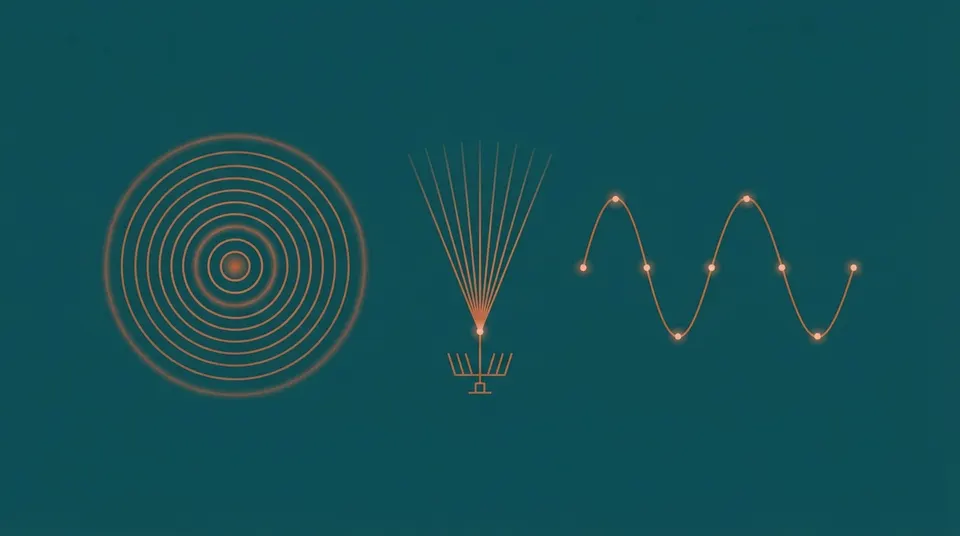
The word "Bluetooth" in the sentences hides three different technologies with an exact difference of an order of magnitude: beacons by signal strength, angular detection with an antenna array, and phase distance measurement, which appeared in Bluetooth 6.0. Let's look at what works today, what a silicone bracelet with a tag can do, and why a wet guest hand is the worst mounting position for the radio tag.
Wi-Fi: What's left of tracking after MAC randomization
Passive collection of MAC addresses of smartphones was the cheapest flow analytics, and address randomization in iOS and Android broke it. We analyze what exactly has stopped working, why de-randomization is a bad idea both technically and legally, why in Russia "anonymous guest Wi—Fi analytics" is impossible by definition, and what really came to replace it: Wi-Fi RTT and sensing according to the 802.11bf standard.
Cameras and AI: how people, zones and routes are actually considered
Which models really count people in 2026, what do the MOTA and IDF1 figures mean for the management report, why the guest's through route through forty cameras is the most expensive and fragile promise in video analytics, and why re—identification does not work in principle at the water park. Plus a separate warning about the "counting unique visitors" modules on face recognition.