Where the guest goes: task map and solution map
Tracking the movements of visitors is not one technology, but five different systems with a price difference of two orders of magnitude. We analyze which tasks they close, what level of accuracy is needed for each, and why the choice of technology is the last solution, not the first.
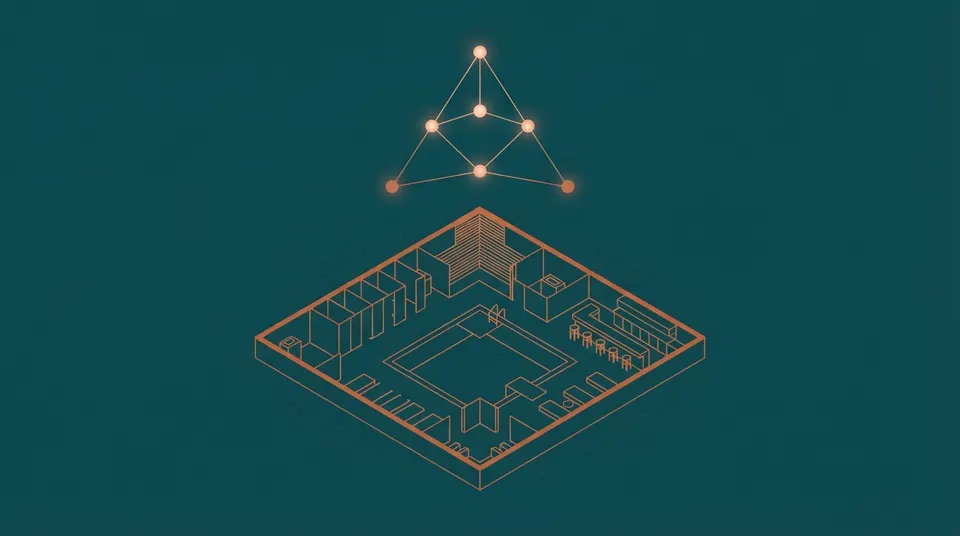
The manager of the thermal spa complex knows two figures about his facility: how many guests entered and how much they paid. There are four hours of each guest's life between these two figures, and almost nothing is known about them.
An empty zone on the second floor on a Saturday evening — is it a bad layout, bad light, or just no one knows that there is a zone there? The queue at the bar at 19:40 is there a shortage of a bartender at 19:40 or so all evening? Are the lockers fully occupied when the complex is loaded at sixty percent — do the guests keep two or half of the lockers are occupied because the bracelet was not returned? The bath attendant is standing idle in the steam room while ten people gather at the hammam — is this an accident of one evening or a stable pattern that can only be seen in the data?
The question "where does the guest go" sounds like one question. In fact, there are five different systems behind it with different architectures, different legal consequences and a difference in cost by two orders of magnitude. The most common mistake when choosing is to buy a fifth system when a second one was needed. The second most common is to buy the first one and wait for answers from it that it does not physically give.
This article is a map. She does not answer which technology to take: for this there are the other twelve articles in the series. It answers the question that needs to be solved before choosing a technology, and without which any comparison of "UWB vs. Bluetooth" is meaningless: what kind of task are you closing and what resolution is sufficient for it.
Five levels of measurement
All motion tracking systems, no matter what physics they use, answer one of five questions. The levels are arranged in ascending order of what the system knows, but not in ascending order of price — and this is the first thing to remember.
Level 0. Presence and account
How many people are in the zone now. How much has passed in an hour. The system doesn't know who it is or where it came from—it only knows the number.
It is closed with a turnstile at the entrance, a 3D counter above the opening, a radar presence sensor, and video counting. The cheapest level and the only one that creates almost no legal obligations: the number of people in the room is not personal data.
What gives: compliance with capacity, loading by hours and days, entrance capacity, cleaning and placement of personnel in fact, and not on schedule. For a bathhouse at three hundred meters and for a shopping center at forty thousand, this is the same level — the difference is only in the number of sensors.
Level 1. Zone
In which zone the object is located. Not a coordinate, but the answer is "in the wet zone", "in the bar", "in the steam room", "on the third floor".
It is closed with RFID reading points on the aisles, Bluetooth receivers by zones, video analytics with drawn zones, presence sensors in each room. It is fundamentally cheaper than coordinate systems, because it does not require overlapping the entire area with a density sufficient for triangulation: it is quite confident to distinguish one zone from another.
What gives: loading each zone separately, time in the zone, simultaneous loading of several zones (and this is already about the capacity of the steam room and the queue for it), the presence of an employee in the area of responsibility.
Level 2. Route
The sequence of zones and transitions between them. Not "the guest was in the bar," but "the guest came, twenty minutes in the locker room, forty in the pool, bar, steam room, bar, shower, exit."
This is the same level 1, but with the same order and linking events to a single session. The technical difference is less than it seems: if the system already knows the zone, the route is almost free. The difference is in the data model and in the fact that to stitch the chain, you need a session ID, which means you need level 4, at least in an impersonal form.
What gives you: a visit funnel and zone conversion, typical scenarios ("classic route" vs. "came, swam, left"), points where the guest gets lost, sequences with and without sales.
Level 3. Coordinate
Position in meters or centimeters, updated from once every ten seconds to ten times per second. Full—fledged real-time positioning is what the industry calls RTLS.
Closes UWB, Bluetooth with angular detection, accurate video tracking, hybrids. The most expensive level in terms of infrastructure, because it requires overlapping the area with receivers with sufficient density: approximately one anchor per 150-300 m2, according to Pozyx, and this is without taking into account the fact that each anchor needs to be connected with a cable.
What gives: scenario effects and shows, motion analytics (not "I was in the hall", but "how I moved around the hall"), real-time security with reference to a point on the plan, control of the convergence of man and technology.
Level 4. Identity
Linking movements to a specific person, contract, subscription, employee.
And here is the main thing that is confused: identity is not above accuracy — it lies in a different plane. The camera can determine the position with an accuracy of thirty centimeters and have no idea who this person is. The bracelet on the guest's hand knows exactly who he is, and at the same time does not know where he is — until the guest puts the bracelet to the reader. These are two independent axes, and expensive accuracy does not mean that the system has become more aware of the person.
The practical conclusion from this is simple and unpleasant for accuracy sellers: if you need personalization and accounting, and not a coordinate, then the cheapest technology of all is the one that you most likely already have. A bracelet with a chip provides the fourth level for the cost of the bracelet.
| Level | What question does it answer | Typical technologies | The order of costs | Legal weight |
|---|---|---|---|---|
| 0. Presence | How many people | Turnstile, 3D counter, radar, video counting | Low | Minimal |
| 1. Zone | Where exactly (in which zone) | RFID reading points, Bluetooth zones, Video by zones, Presence sensors | Low — medium | Medium |
| 2. The route | In what order | The same plus the session data model | Medium | Medium — high |
| 3. Coordinate | Where accurate to meters and centimeters | UWB, Bluetooth AoA and Channel Sounding, Video tracking | High | Medium — high |
| 4. Identity | Who is it | Bracelet and card, app, Face recognition | From low to very high | High, critical for biometrics |
The line about identity does not accidentally give such a spread. The bracelet is cheap and the legal regime is manageable. Face recognition is expensive and in Russia it is regulated by a separate law so rigidly that for most objects it is a closed door. The analysis is in the article about the law.
Five groups of tasks and a minimum level for each
Now on the other hand: what the manager wants to get and what minimum level is needed for this. "Minimal" is the key word. Overpayment for extra levels is the main item of senseless expenses in this topic.
Money
| Task | Minimum level | Delay |
|---|---|---|
| Loading by hours and days, tariff schedule | 0 | Report per day |
| Conversion of the zone into a purchase (bar, massage, additional services) | 2 plus yandex.Checkout data | Weekly report |
| Turnover of lockers, sunbeds, cabins | 1 (or locks data) | Report per day |
| Session processing and additional payment | 4 | Real time |
| Empty zones and dead hours | 0–1 | Monthly report |
The most underrated line here is the zone conversion. In the thermal Spa complex, the pool bar and the entrance bar are sold differently, not because the bartenders are different, but because different flows in different conditions pass through them. Without data, this is discussed at the level of opinions.
Operations
| Task | Minimum level | Delay |
|---|---|---|
| The capacity of the entrance group, the queue at the reception | 0 | Real time plus report |
| Placement of personnel by actual load | 1 | Real time |
| Cleaning schedule by aisles, not by the hour | 0–1 | Real time |
| Capacity control of the zone (steam room, hammam, swimming pool) | 0 per zone | Real time |
| The presence of an employee in the area of responsibility | 1 plus 4 | Real time |
Security
| Task | Minimum level | Delay |
|---|---|---|
| Drowning detection | Specialized video | Seconds |
| Falling in the shower or locker room | 0 with pose recognition, without image | Seconds |
| The guest in the steam room is longer than normal | 1 plus 4 | Minutes |
| The lost child | 1 plus 4, better than 3 | Minutes |
| Accumulation, evacuation, "who stayed inside" | 0-1, for the list — 4 | Real time |
| Employee alone in the danger zone, alarm button | 3 plus 4 | Seconds |
Security is the only group where the delay is measured in seconds, and the only one where the cost of an error is not expressed in money. Therefore, she has a separate article in the series: there are other requirements, other suppliers and another conversation about responsibility.
Service
| Task | Minimum level | Delay |
|---|---|---|
| Virtual queue (attraction, massage, scheduled hovering) | 4, Location is optional | Minutes |
| Navigation through a large complex | 3 on the guest's smartphone | Real time |
| Scenario effects in the show and quest | 3 with high frequency | Tens of milliseconds |
| Personal tips ("your session in ten minutes") | 1 plus 4 | Minutes |
The line about the virtual queue is a good example of how the task looks more complicated than it is. To remove the queue for hovering, you don't need to know where the guest is: you need to know that he is recorded and be able to call him. This is not a positioning system, but a schedule and notification channel. Systems like accesso LoQueue in amusement parks are largely built that way.
Accounting
| Task | Minimum level | Delay |
|---|---|---|
| Visit time, tariff, surcharge | 4 | Real time |
| Equipment rental (towel, bathrobe, locker) | 4 plus a label on the inventory | Real time |
| Employee's time by zone, production | 1 plus 4 | Shift report |
| Search for equipment, carts, tools | 1-3 on the label | Real time |
Three questions that determine the choice
From the entire matrix of tasks and levels, the solution is pulled out by three binary questions. They seem primitive, but it is on them that projects stumble.
The first question is: is the label on the guest acceptable?
Bracelet, card, badge. In the thermal spa complex, water park and fitness club, the answer is "yes" by default: the bracelet is already on the hand, it is needed for the locker and payment. In a shopping center, a museum without a bracelet ticket, on a food court, in a clinic, the answer is "no", and this immediately cuts off half of the technology. In production, a label on an employee is possible, but this is a conversation with the team, not a technical solution.
Question two: Is identity needed?
Is it necessary to associate the movement with a specific person or is an impersonal flow enough. "How many people have passed through the hammam" and "how many times this guest has entered the hammam" — the difference in legal obligations is enormous, and in business value is often small. Many tasks for which they are going to pay with identity are solved by impersonal numbers.
Question three: do you need a reaction now or a report later?
Real time is more expensive than reporting at times — not because of sensors, but because of everything else: fault tolerance, communication channels, duty, reaction regulations, integration with the workplace of personnel. A system that sends an alarm, but there is no one to accept it, is useless and even harmful: it creates a false sense of control.
Three questions give eight combinations, and almost every one is uniquely mapped to a class of solutions:
- No label, no identity, report. Counters at the entrances and in the zones, video counting. The cheapest scenario, the most frequent real request.
- No label, no identity, real time. Sensors of presence and occupancy, capacity monitoring, event detection by video and radar.
- Without a label, with an identity. Face recognition or a guest app. The first in Russia is almost closed by law, the second is limited to the proportion of those who installed the application.
- With a label, without an identity. Impersonal bracelet: number without reference to full name. An undervalued combination — gives routes and remains in a soft legal regime.
- With a label, with an identity, a report. The classic bracelet of the thermal spa complex plus normal event analytics. What most people already have and almost no one reads.
- With a label, with an identity, real time. Full-fledged RTLS: UWB, Bluetooth with angular definition, hybrids. Scenario effects, staff safety, sports.
Where to start at the facility
The bracelet, readers and access controller already give visit events, and the accounting database turns them into reports.
Silicone RFID Wristband for Wet Areas
One bracelet is a pass, a locker key and a guest bill. Withstands water, chlorine and high temperature.
Request a KPWall-mounted card reader and wristbands
Reads RFID wristbands and cards at the entrance to the zone. The backlight shows the guest if he is missed. Vandal-proof housing withstands wet areas.
Request a KPAccess controller for a group of access points
Manages turnstiles, doors and locks of the entrance group. Stores events at home and continues to let guests through, even if the connection to the server is lost.
Request a KPThe accounting database for your data
A web database for accounting that has outgrown Excel, but does not fit the standard program: contracts, objects, rights, counterparties and relationships between them. Fields and relationships are described by the setting, so we quickly assemble the database for your process and refine it without rewriting.
Request a KPTechnology map
The summary table is not for selection, but for orientation: which technology is playing at what level. The accuracy figures in it are intentionally given by ranges, and the next article in the series explains why any one digit of accuracy without measurement conditions is marketing.
| Technology | Level | Label | Smartphone | Identifies | Accuracy | Steam and water | Maturity 2026 |
|---|---|---|---|---|---|---|---|
| RFID HF (wristband, card) | 1, 2, 4 | Need | I don't | Yes | Reading point | Great | Mature |
| RFID UHF (portal, grid) | 0, 1, 4 | Need | I don't | Yes | Zone, 1-5 m | Good | Mature |
| Bluetooth RSSI (beacons) | 1 | Need | Opts. | Yes | 3-5 m, actually a zone | Moderately | Mature |
| Bluetooth AoA | 1, 3 | Need | I don't | Yes | 0.3–1 m declared | Moderately | Mature |
| Bluetooth Channel Sounding | 1, 3 | Need | Opts. | Yes | 0.3–1 m | Moderately | Early |
| UWB | 3, 4 | Need | I don't | Yes | 10-30 cm | Good | Mature, dear |
| Wi-Fi (probe request) | 0 conditional | I don't | Need | I don't | 5-15 m | — | Degraded |
| Wi-Fi RTT (802.11az) | 3 | I don't | Need | I don't | 1-5 m | — | Early |
| Wi-Fi Sensing (802.11bf) | 0 | I don't | I don't | I don't | Presence | Unknown | Early |
| Video and AI | 0, 1, 2, 3 | I don't | I don't | Optional | 0.3–2 m | Bad | Mature |
| Radar 60 GHz | 0, pose | I don't | I don't | I don't | Presence, 0.5–2 m | Good | Average |
| 3D counters, ToF, LiDAR | 0 | I don't | I don't | I don't | Up to 99 % of the invoice is declared | Depends on the model | Mature |
| Smartphone with navigation SDK | 1, 3 | I don't | Need | Yes (account) | 1-5 m | Moderately | Mature |
| GNSS and LoRaWAN | 1, 3 outside | Need | I don't | Yes | 5-20 m | Outside | Mature |
Two rows in the table are worth reading carefully, because they contradict expectations.
Wi-Fi by probe request — no longer works as sold. Passive collection of MAC addresses of smartphones was the cheapest way to analyze streams, and it was broken by MAC randomization, which became default in iOS 14 and Android 10. One guest turns into a dozen "unique visitors". Analysis in the article about Wi-Fi.
Video in the wet zone is not a universal answer. Steam, condensation on the optics, glare and refraction on the water, the contour of panoramic glazing: in the thermal spa complex, the camera loses exactly where it is most interesting. And in the locker room and shower, it cannot be installed in principle — and this is the case when the restriction is not circumvented technically, only by replacing the technology.
Guest and employee: the same physics, different law
The same anchor on the ceiling of the workshop serves the person and the loader in the same way. But the guest person and the employee person are in different legal regimes, and this changes the project.
A guest. The basis of processing needs to be selected: consent, contract, legitimate interest — everyone has their own boundaries. The guest is not required to wear a tag, but accepts the rules when entering the territory. An impersonal account at the entrance creates almost no obligations; a route linked to an agreement creates them completely.
An employee. Labor relations provide a basis for process control, but require registration: a local regulatory act, notification, sometimes consent. And they give a side effect that is not present with the guests: the mark on the person who is obliged to wear it changes the relationship in the team. Personnel tracking projects fail not because of accuracy, but because of sabotage - the tag is forgotten in the locker, and statistics turn into fiction.
In practice, this means that the system that was built "for guests" does not automatically apply to staff, even if the hardware is the same. These are two projects with a common infrastructure. For more information, see the article about the law.
Why implementations fail
Five plots that are repeated most often in this topic. Everyone is sorted out in their article series, here — to get to know themselves in advance.
Bought accuracy, which is not used. UWB with centimeter accuracy for the sake of a heat map, which is viewed once a month. The difference in cost between the zonal system and the coordinate system is a multiple, and the difference in the decisions made is zero.
Bought data instead of solutions. The system is working, the dashboard exists, it was opened twice. Data on movements does not bring money by itself: they bring decisions that are made on them. This is such a frequent ending that a separate article is devoted to it.
We put the equipment where it is impossible. Cameras in the locker room, shower, steam room. It usually turns out not at the check, but at the first complaint.
They believed the accuracy figure from the presentation. "Ten centimeters" in line of sight on an empty landfill and the same ten centimeters on a Saturday evening in a crowded water park are different numbers. How to read such figures and how to record acceptance in the contract is the next article in the series.
Not associated with the accounting system. Attendance at the turnstile, at the ticket office, on bracelets and on video give four different numbers, and a dispute begins as to which is correct, instead of working with data.
The order in which it is worth solving this
- Name the decision you want to make. Not "we want analytics", but "we want to understand whether to put a second bartender from 18 to 21" or "we want to reduce the queue at the entrance on Saturday."
- Define the metric. What exactly we measure, in what units, with what frequency, with what we compare.
- Output the minimum level. According to the tables above: do you really need a coordinate, do you really need an identity, do you really need real time.
- Impose environment restrictions. Steam, humidity, temperature, metal, water, glass, ceiling height, wet feet and barefoot guests, disinfection.
- Check the legal regime. Before purchase, not after installation.
- Select a technology and test it at your facility. A pilot with control measurements, success criteria and a deadline is part of the contract, not courtesy of the supplier.
- Decide who will use it and how. Who gets the alarm, who looks at the report, what changes in the regulations. Without this step, the previous six don't make sense.
Separately, about market estimates, which they like to give in presentations. Analytical agencies differ in their assessment of the same RTLS market at times: according to Grand View Research, the volume of the medical segment alone in 2026 is about $ 3.3 billion, according to Precedent Research — about $4.06 billion, and individual reports give a base twice as high. This is the normal state of a young market with blurred boundaries, and there is only one practical conclusion from it: market growth figures are not an argument when choosing a system for your facility. The argument is a measurement on your object.
What will happen next in the series
The following article is methodical and probably the most useful of all: how to read the characteristics of the systems, what is hidden behind the word "accuracy", how the CEP50 differs from the CEP95, why line of sight changes everything, and how to record the acceptance measurement in the contract so that later there is something to refer to.
Then — by technology: RFID and how the bracelet you already have turns into a data source; Bluetooth with its three different generations and a new phase measurement of distance; UWB and the fair price of centimeters; Wi-Fi and what's left of it; video analytics with specific models and their boundaries; critical events — drowning, falling, overheating; solutions without cameras and without tags — radars and sensors for areas where the camera cannot be placed; hybrids and large open areas.
Then — data and metrics, the law and the final comparison with budgets and a checklist of technical specifications.
Let's figure out what to count on your object
Tell us about the object and tasks. Let's offer a minimal set that gives answers, without overpaying for accuracy, which is not used.
- We will respond within a working day
- Let's clarify the task, the zones of the object and the restrictions
- We will propose a solution, a pilot order and an estimate
Is it more convenient in the messenger?
+79262103289Employees respond from 9:00 to 23:00 Moscow time, every day
How can we help
Low-voltage systems
Structured Cabling and local area networks, Wi-Fi, video surveillance, access control systems, sound and video in the halls, server rooms — from survey and project to commissioning and executive documentation. It is better to connect at the construction stage, but we also work with existing facilities.
СКСIP-видеонаблюдениеЗвук по зонамСКУД
System integration
Turnstiles, ticket offices, 1C, CRM and the site begin to exchange data themselves. Employees stop transferring numbers with their hands.
1ССКУДREST APIЭквайринг
Equipment supply
We deliver separately and as part of the project. We select it for the task, not for the warehouse, and we can design, assemble and configure it ourselves.
Серверы и СХДСетевое оборудованиеТурникеты и браслетыIP-видеонаблюдениеFrequent questions
Is it possible to understand the flow of guests without giving anything away and without putting cameras?
Yes, at the level of numbers. Counters at the entrances and in the openings of the zones give loading, throughput and peak times without labels, without cameras and practically without legal obligations. What they will not give — the route of a particular guest and identity.
Do I need the consent of the guest to count it?
For impersonal counting of people — as a rule, no: the number of visitors in the room does not apply to personal data. As soon as a link to a person appears — a contract, a bracelet with a full name, a face image — the mode changes completely. The border is discussed in the article about the law.
We already have bracelets and turnstiles. Is that enough?
For most tasks from the groups "money", "operations" and "accounting" — yes, that's enough, provided that the events of the bracelet are saved and have access to them. Most often they are written to a magazine that no one uploads. This is the cheapest first step: start reading what is already being collected.
How much does it cost to start?
It costs less to get started than it seems: a pair of counters at the entrance and unloading wristband events give the first answers within the cost of one piece of equipment. A real-time coordinate system for the entire area is expensive: for submeter accuracy, open estimates give 15-40 € per m2 of infrastructure, with cable, power and installation ranging from 60 to 85% of the budget. The analysis of prices is in the article about UWB and in the final one.
If you put cameras, will they close all tasks at once?
No. The camera counts people well in the lobby, works poorly in pairs and on the water, is not installed in the locker room and shower, and does not know who is in front of it if you do not turn on facial recognition — and this is a separate and very strict legal regime in Russia. Video is a strong tool in its zone of applicability, and articles 7 and 8 of the series are devoted just to the boundaries of this zone.
Is it possible to calculate in advance how much the system will bring?
The honest answer is: not reliably, unless you have a basic measurement. Vendor cases with revenue growth by tens of percent are not transferred to another facility. The right way is to first measure what is there, then change one factor at a time and compare it with the control zone or a comparable period. How to do this — in the article about data and metrics.
Sources
Sources
- Pozyx — density of UWB anchors (manufacturer's data)
- ISO/IEC 24730-1:2014 — RTLS family of standards, accuracy classes
- accesso LoQueue — virtual queue at amusement parks
- Grand View Research, Precedent Research — RTLS market estimates (agency data differ from each other)
- Purple — the impact of MAC randomization on Wi-Fi analytics (vendor data)
- Tracio, RTLS cost guide — the order of costs for the positioning infrastructure
Other articles in the series
How to read the characteristics: accuracy, delay, identity, coverage
"Accuracy of 10 cm" is not a characteristic, but a fragment of a phrase. We analyze what is behind the numbers in the commercial offers: CEP50 and CEP95, line of sight, anchor geometry, delay vs. refresh rate, capacity during rush hour. And how to record the acceptance measurement in the contract so that later there would be something to refer to.
Bracelet as a key: RFID from locker to Flow analytics
The silicone bracelet of the thermal spa complex writes the events "entrance", "locker", "bar", "exit" every day — this is a ready-made visit funnel that almost no one reads. We analyze what RFID can and cannot do, how Classic differs from DESFire and why it is a matter of money, how to assemble a route from the marks on the reading points and where this route lies.
Comparison and selection: what to take for your task and what it will cost
The result of the series: a summary table of all tracking technologies, a selection tree, nine typical scenarios with recommended stacks, a cost of ownership structure (where cable is more expensive than equipment), a restriction bypass matrix, a pilot plan for 4-8 weeks, a checklist of technical specifications and a forecast for 2026-2028.